 PokéSlot
An arcade game for collecting all 151 Kanto Pokémon
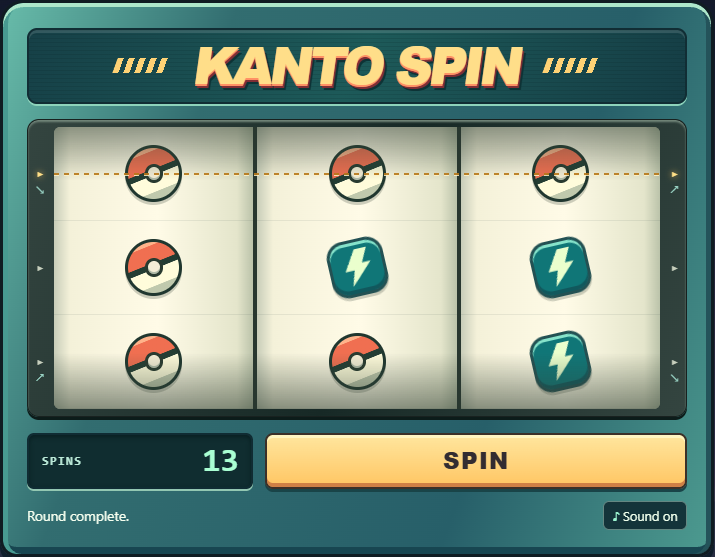
I designed PokéSlot as a three-reel arcade game with a longer goal: collecting all 151 Kanto species. I led product and architecture decisions from the first balance test through the release of the machine in English and Portuguese.
Why give players a choice?
Early on, almost every catch reveals a species. By the end, even a rare catch can be a duplicate. Pokémon vouchers let a player choose a missing normal species. With a stone voucher, the player picks the stone for an evolution.
I compared progression scenarios before choosing three equally likely vouchers and 72 evolutions. Across 1,500 simulated playthroughs with up to 25 rounds a day, the median time to complete Kanto was 61 days under the model’s redemption strategy.
What if a spin’s response gets lost?
I wanted the player to be able to recover the round. A Neon Function checks identity and draws the result on the server. PostgreSQL records the debit, rewards and result together. If the response gets lost, the interface retries with the same operation ID. Switching accounts keeps items and results with the player who performed the action.
What we verified
- Two accounts, one machine
- Using inventory prepared for the test, player C redeemed Pikachu, evolved it into Raichu and recovered both after reloading. Signing in as player B showed B’s own inventory.
- Account recovery
- I received the email in a controlled inbox and reset the password. After we enabled session revocation, the previous tab required a fresh login and the balance was recovered.
- Keyboard and screen reader
- On the hosted machine, a keyboard spin took the balance from 25 to 24. The balance persisted after a reload. I heard the announcements with Windows Narrator.